How small can a smart model get?
Open-weight model size vs. capability, Dec 2024 – Jul 2026
With the release of DeepSeek V4 I wanted to see how model sizes are trending over time. What surprised me is that DeepSeek V4 Flash is extremely capable and small enough to run on a setup you could build for under $50,000 — expensive, but not a datacentre. So I pulled together the open-weight models with published parameter counts and their current Artificial Analysis Intelligence Index scores, and made the two plots below with Opus/Sonnet 5.
I am not an expert in LLMs, and there are surely physical limits to how much you can squeeze into a small model. But I don't know how close we are to them — small models may have a long way to go before saturating. If the trend holds, we should have Opus 4.5–level models (roughly an AA score near 40) running on an ordinary MacBook Air or Pro by this time next year.
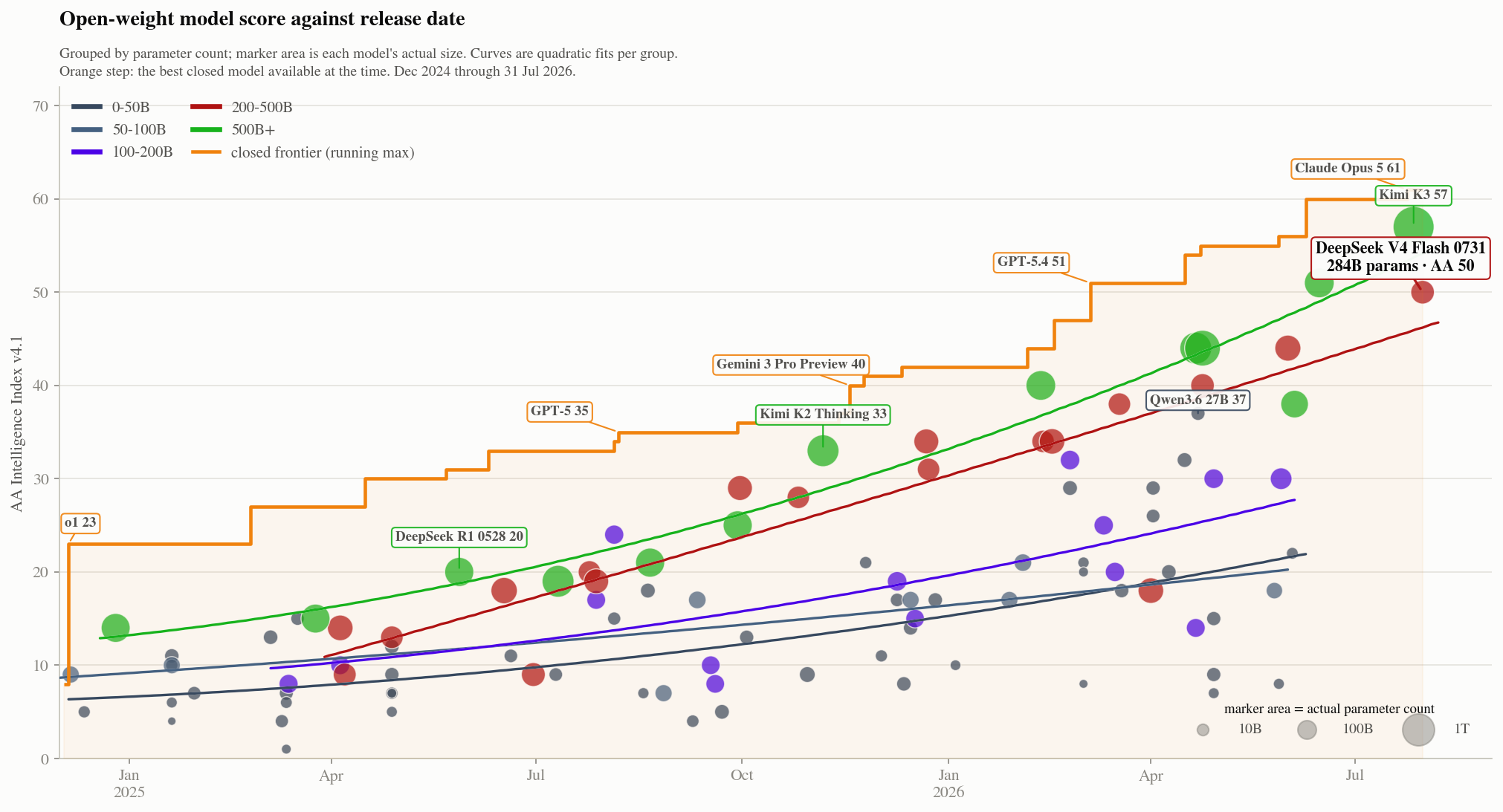
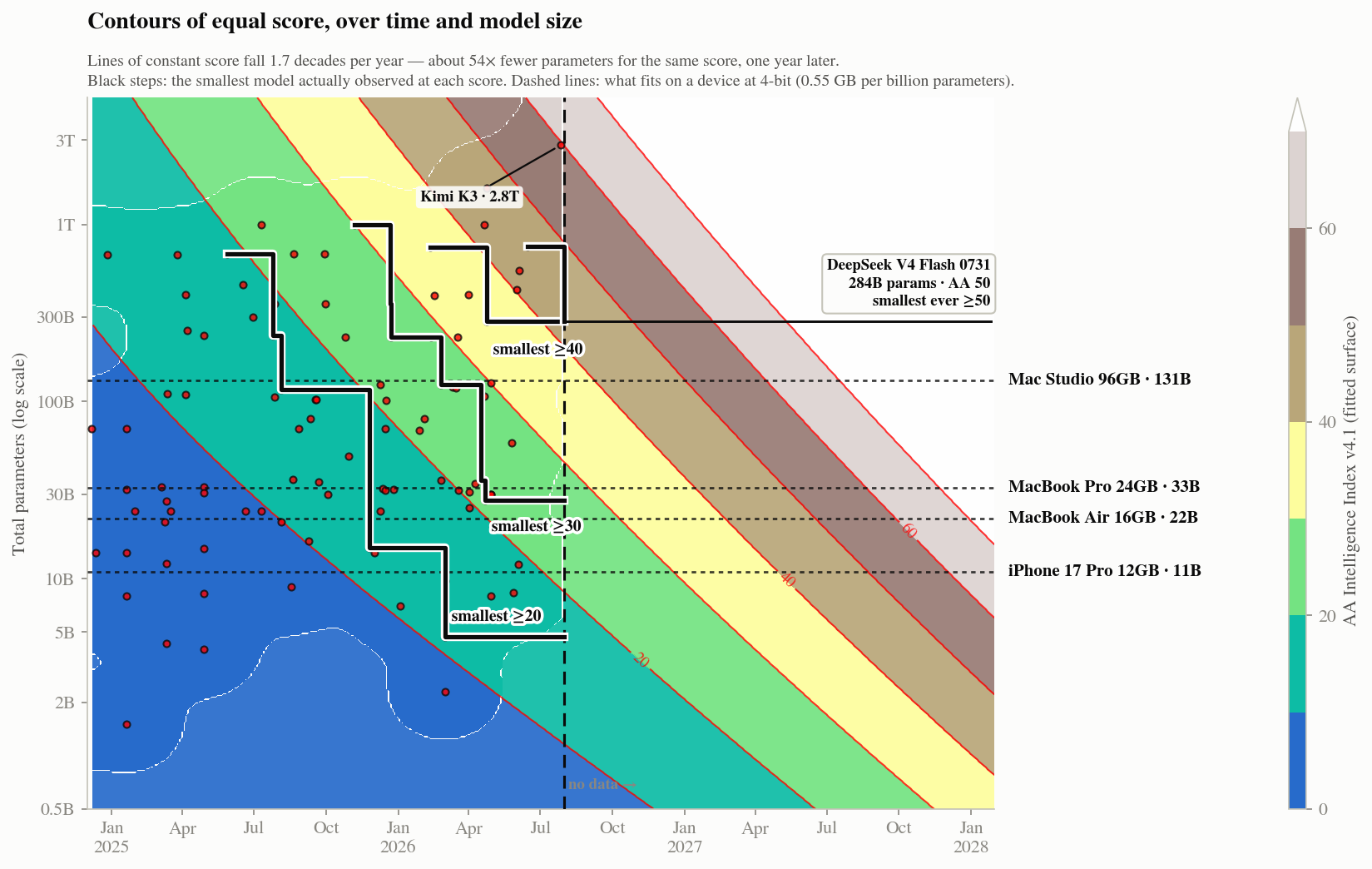
Caveats: I don't trust the trend above a score of 40 — there are very few data points up there. Some scores are Artificial Analysis estimates rather than measured runs, reasoning and non-reasoning variants are a several-point confound, and release date is not the same as training-compute date.